
Petco Park is the home ballpark of the San Diego Padres and one of the defining landmarks of downtown San Diego, California. Opened in 2004 in the East Village neighborhood, the ballpark moved Major League Baseball from Mission Valley into the heart of the city, placing it within walking distance of the Gaslamp Quarter, the San Diego Convention Center, and the waterfront.
Its arrival accompanied a broad transformation of East Village, where warehouses and vacant lots gave way to residential towers, offices, restaurants, and public spaces over the following two decades.
For anyone seeking to understand how downtown San Diego took its current shape, Petco Park offers an essential lens on the city’s modern urban development.
From Mission Valley to East Village
Before Petco Park, the Padres shared a stadium in Mission Valley with the city’s professional football team. The valley takes its name from Mission San Diego de Alcalá, the Spanish mission that relocated there in the 1770s, and it remained the center of the city’s major league sports for decades.
By the 1990s, team leaders and civic officials began pursuing a baseball-only ballpark downtown, arguing that it could anchor new investment in a part of the city that had seen little development. San Diego voters approved a ballot measure authorizing public participation in building the ballpark and redeveloping the surrounding district.
The project did not move forward smoothly. Lawsuits challenging the project slowed its progress, although the city prevailed in court. In 2001, following a conflict-of-interest case involving a city councilmember, the City Council voted again to reaffirm the ballpark agreements, and a dispute over preserving a historic building added further delays. Work eventually resumed, and the ballpark hosted its first regular-season game in April 2004. The San Diego Padres maintain current information on the ballpark’s features, events, and visitor services.
Design and the Western Metal Supply Building
Petco Park’s design reflects San Diego’s setting rather than imitating older eastern ballparks. Architects used sandstone-colored stone and white steel to echo the region’s coastal cliffs and sailboats, and they opened the ballpark’s sightlines toward the city skyline and San Diego Bay.
Walkways, terraces, and landscaped areas around the concourses give the venue an open, outdoor character suited to the mild climate. The ballpark’s most recognizable feature is the Western Metal Supply Co. building, a brick warehouse dating to the early 1900s. Rather than demolishing it, designers incorporated the building into the left-field corner, where it now holds seating, suites, and a team store.
Its preservation connects the modern ballpark to East Village’s industrial past and shows how the neighborhood’s older buildings could be adapted for new uses.

East Village Redevelopment
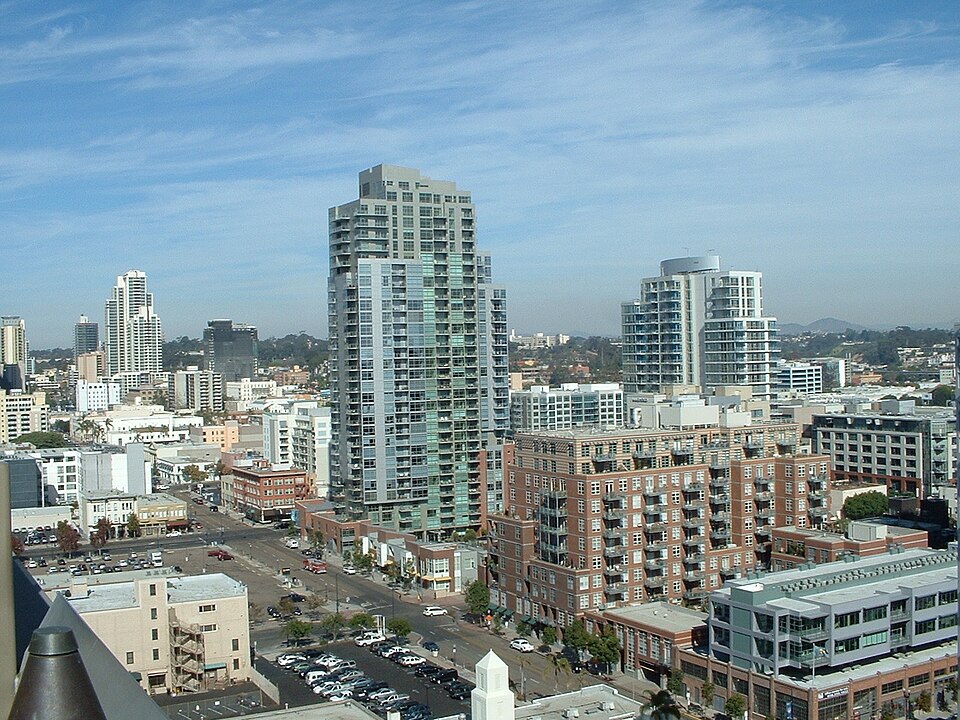
Petco Park was intended to be more than a ballpark, and the surrounding district has changed dramatically since it opened. Former industrial land in East Village now holds high-rise apartments and condominiums, office buildings, hotels, and street-level restaurants and shops.
The Ballpark Village development and nearby residential projects brought thousands of new residents into an area that once had relatively few.
Public space is part of that change. A grass park area beyond the outfield, known as the Park at the Park and later renamed Gallagher Square, serves as a gathering space on game days and as a neighborhood park when the ballpark is not in use. Its location also links the ballpark to transit.
San Diego Metropolitan Transit System trolley stations sit close to the ballpark, giving fans and downtown residents an alternative to driving. The San Diego Metropolitan Transit System publishes trolley routes and schedules that serve the ballpark district.
San Diego’s Climate and Year-Round Use
San Diego’s mild coastal climate allows Petco Park to operate without a roof and supports a busy schedule of events beyond baseball. San Diego experiences a Mediterranean climate with warm summers averaging July highs near 76°F, mild winters with average January lows near 50°F, and roughly 10 inches of annual precipitation, according to the NOAA climate data for San Diego, California.
Rain is concentrated in the winter months, while the baseball season from spring through early fall falls largely within the dry season. Coastal weather patterns still shape the experience. Late spring and early summer often bring a marine layer, the low clouds locally called May Gray and June Gloom, which can keep evening games cool and overcast, much as it does along the shore in coastal neighborhoods such as La Jolla.
Late summer and early fall usually bring sunnier skies and warmer temperatures. Outside the baseball season, the ballpark hosts concerts, community events, and international baseball tournaments, and it hosted the Major League Baseball All-Star Game in 2016.
Petco Park’s Role in Downtown Identity
Petco Park’s significance to San Diego extends well beyond baseball. The ballpark gave East Village a recognizable center and helped shift how residents and visitors think about downtown, which now functions as a neighborhood where people live as well as work and visit.
Game days bring crowds to nearby restaurants and transit stations, while the surrounding parks and plazas serve local residents throughout the year. The ballpark also remains part of an ongoing civic conversation about public investment, development, and the role of sports venues in city life.
Supporters point to the growth of East Village as evidence of the project’s value, while others continue to debate the costs and tradeoffs involved. For anyone exploring the urban history and civic character of San Diego, California, Petco Park remains a central landmark in the story of how downtown took its current form.