
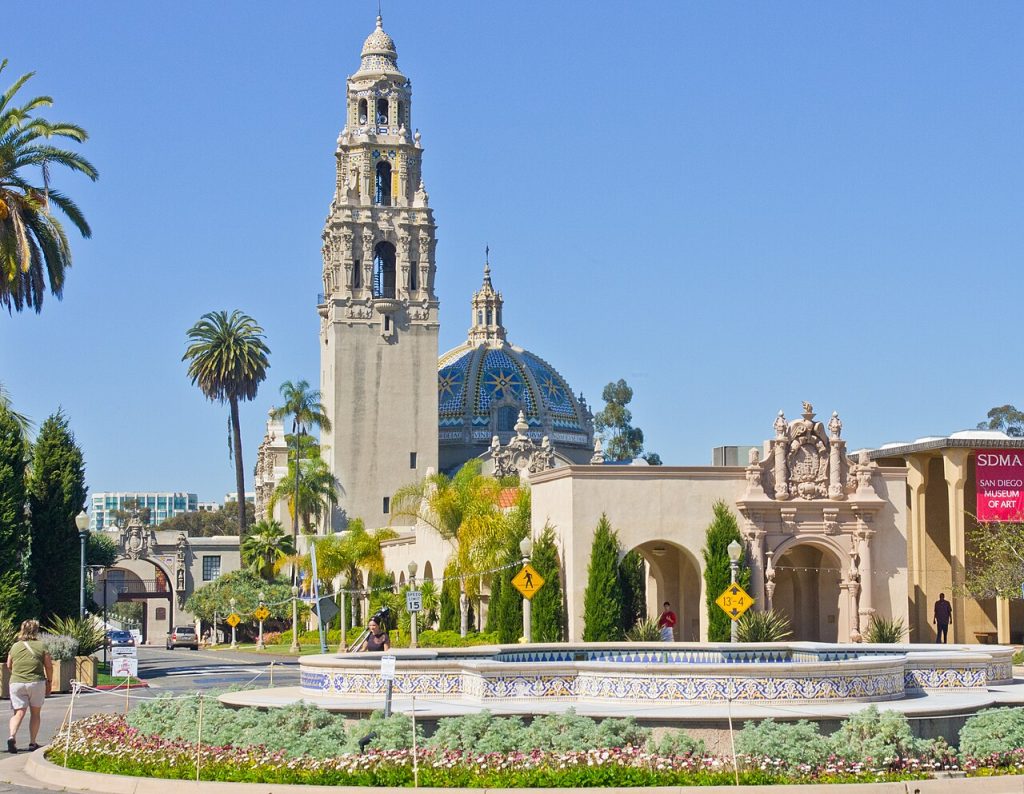
Balboa Park stands as one of the oldest urban green spaces in the United States, and its 1,200 acres sit at the heart of San Diego‘s civic identity. For residents and property owners throughout the city, the park is not simply a recreational amenity but a living record of how San Diego grew from a small pueblo into a major American city.
Understanding its history offers insight into the architectural styles, land-use decisions, and public planning traditions that still shape neighborhoods surrounding the park today.
Origins as Common Land for the Public
The land that became Balboa Park was set aside long before San Diego resembled a modern city. In 1835, authorities under Mexican rule reserved roughly 1,400 acres of pueblo land for public recreational use, a decision that predates California statehood.
That early designation is why historians consider the site one of the oldest tracts in the country dedicated specifically to public leisure. San Diego’s Board of Trustees formalized the reservation in 1868, creating what residents simply called “City Park.”
For several decades afterward, the park remained largely undeveloped chaparral, home to coyotes, rattlesnakes, and native wildflowers rather than cultivated gardens. City leaders fended off repeated attempts to sell off portions of the land to private developers, a pattern of civic protection that established a precedent still reflected in San Diego’s park-preservation policies.
This grassroots defense of public land helped San Diego become just the second American city, after New York’s establishment of Central Park, to formally dedicate such a large tract for shared use.

San Diego’s Climate and the Making of an Urban Garden
San Diego’s Mediterranean climate, marked by mild temperatures, low humidity, and limited rainfall concentrated in winter months, made the park’s transformation into a botanical showcase possible. Unlike cities with harsh winters or heavy seasonal rainfall, San Diego’s consistent conditions allowed exotic and native plantings to thrive with relatively modest irrigation.
This climate advantage became central to the park’s development in the early twentieth century. Horticulturist Kate Sessions, often called the mother of Balboa Park, leased land within the park for a nursery in the 1890s and donated trees and plants to the city each year in exchange.
She championed drought-tolerant and California native species long before water conservation became a widespread regional priority. Her work established planting traditions that still inform how San Diego’s public gardens balance visual abundance with the realities of a semi-arid environment.
The Panama-California Exposition and a New Architectural Identity
The park’s name and appearance changed dramatically in preparation for the 1915 Panama-California Exposition, a world’s fair organized to celebrate the opening of the Panama Canal and San Diego’s position as the first American port north of it. City officials renamed “City Park” as Balboa Park around 1910, honoring the Spanish explorer Vasco Núñez de Balboa.
Architect Bertram Goodhue led the design effort, choosing an ornamental style that blended Spanish Baroque and Spanish Colonial detailing into what became known as Spanish Colonial Revival architecture, a decorative building style characterized by domed towers, tiled roofs, and elaborately carved facades. Detailed accounts of the fair appear in the San Diego History Center’s journal.
That architectural choice proved so influential that it became a defining aesthetic across Southern California for decades afterward. Several structures built for the 1915 exposition remain standing today, including the Cabrillo Bridge, the California Tower, and the Botanical Building.
A second world’s fair, the 1935 California Pacific International Exposition, added further landmarks such as the Old Globe Theatre and Spanish Village, reinforcing the park’s role as an architectural laboratory during the Great Depression.

Landmark Status and Historic Preservation
Recognition of the park’s historical significance grew steadily through the twentieth century, culminating in formal federal protection. A National Historic Landmark is a building, site, or district recognized by the National Park Service as holding exceptional value in illustrating American heritage.
Balboa Park and its exposition-era buildings received this designation, along with a listing on the National Register of Historic Places, in December 1977. The park’s key preservation milestones include the following:
- San Diego Historic Landmark designation in 1967
- National Register of Historic Places listing in 1977
- National Historic Landmark District designation in 1977
- California Cultural District designation in 2017
These layered protections mean that changes to the park’s historic core face additional regulatory review compared with typical municipal property, a factor that has shaped several San Diego planning debates over parking and traffic access in recent decades. Civic organizations, including a preservation-focused nonprofit formed in the 1970s, have repeatedly stepped in to restore deteriorating exposition buildings rather than allow their demolition.
A Living Cultural Institution Today
Balboa Park’s role has extended well beyond architecture and gardens over the past century. During both World War I and World War II, the federal government converted portions of the park into military training grounds and hospital facilities, temporarily suspending its recreational use for national defense needs.
Once returned to civilian control, the park resumed its growth as a cultural hub, eventually housing more than a dozen museums, numerous gardens, and the San Diego Zoo. Today, Balboa Park draws millions of visitors annually and remains central to how San Diego presents its history to residents and newcomers alike. Its many museums and gardens continue to build on that legacy year-round.
Its combination of preserved architecture, climate-adapted landscaping, and continuous civic stewardship illustrates how one piece of protected land shaped the identity of an entire region. –